
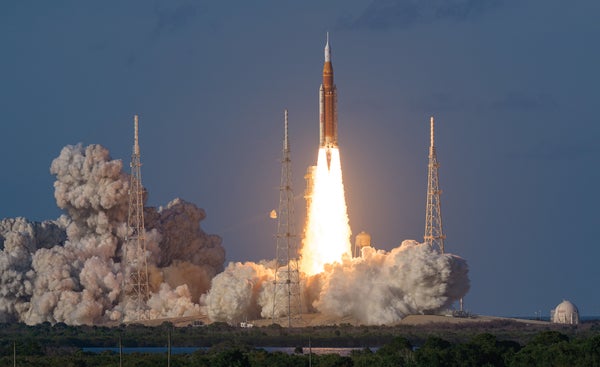
For several days in April, four humans lived closer to another world than to our own. By the time they splashed down in the Pacific Ocean, the crewmembers of NASA’s Artemis II mission had flown farther from Earth than anyone else ever had. They became the first people to rendezvous with the moon in nearly 54 years. And for the first time, a woman’s braids floated in deep space, an astronaut of color piloted a moon ship, and a Canadian radioed home from beyond the moon’s cratered farside.
But these four astronauts—commander Reid Wiseman, pilot Victor Glover, mission specialist Christina Koch, and mission specialist (and rookie Canadian astronaut) Jeremy Hansen—represent more than a superlative series of firsts. Through their unwavering focus on joy and unity, the Artemis II astronauts forged a path forward not only in space but arguably on Earth as well. “This mission was about the way back to the moon, but I think it was also a way back to ourselves, to a more perfect union—or our better angels, whatever metaphor you want to use,” says Jordan Bimm, a space historian at the University of Chicago.
On supporting science journalism
If you're enjoying this article, consider supporting our award-winning journalism by subscribing. By purchasing a subscription you are helping to ensure the future of impactful stories about the discoveries and ideas shaping our world today.
At 6:35 P.M. EDT on April 1, Artemis II blasted off from NASA’s Kennedy Space Center. As it leaped from the pad, the hulking Space Launch System (SLS)—a 322-foot-tall rocket flanked by boosters emblazoned with a patriotic logo celebrating the 250th birthday of the U.S.—shook the ground for miles around. Some 400,000 spectators had flocked to Florida’s Space Coast to witness the pyrotechnic performance in person. Millions more watched online as Artemis II soared into history.
Tucked into the Orion spacecraft atop the rocket, the mission’s crewmembers had embarked on the first astronautical moon mission since 1972’s Apollo 17. By design, Artemis II would not land on the lunar surface. Instead, somewhat like 1968’s Apollo 8 mission, the crewmembers would follow a looping path that slung them around the moon before returning them to Earth.

Amanda Montañez; Source: NASA (reference)
Their flight path first traced two orbits around Earth, which the crew used to test the spacecraft’s flight capabilities and onboard systems. Then the Orion capsule—which the astronauts named Integrity—fired its main engines in a “translunar injection burn” and set sail for the moon. It took about four days to reach the moon’s sphere of influence. Once there, Integrity followed a trajectory that took it far beyond the lunar farside, ultimately flying 252,756 miles from home and making the Artemis II crew the farthest-flung humans in history. “As we surpass the furthest distance humans have ever traveled from planet Earth,” Hansen said, “we do so in honoring the extraordinary efforts and feats of our predecessors in human space exploration.”
Artemis II was the first in a planned yearslong series of crewed deep-space missions that, if successful, will culminate in the construction of a multibillion-dollar moon base at the lunar south pole sometime in the 2030s. “We have a lot of ambitions for the moon,” says Lori Glaze, acting associate administrator of NASA’s Exploration Systems Development Mission. “Our intent is to build that enduring presence on the moon and, in particular, at the south pole, where no one has ever been before. And the first step in making that happen is Artemis II.”
Both Apollo 8 and Artemis II were launched in eras of remarkable global turmoil.
The mission debuted more than three years after the uncrewed Artemis I flight, and it had a similarly rocky path to the pad. Propellant leaks and other issues with ground systems and the SLS rocket delayed Artemis II by months. Amid those delays, NASA leaders revamped much of the Artemis program’s architecture, which now includes an additional crewed flight before the Artemis IV moon landing, an increased cadence of missions and, going forward, decreased reliance on the budget-busting and finicky SLS to get there.
These plans would have been tough to realize if Artemis II had not been successful. Now, though, we are once again a moon-faring species. “For the past 60 years, almost, more than a generation has not experienced people exploring beyond low-Earth orbit. That’s a big deal,” says Lori Garver, former deputy administrator at NASA. “To be getting back to that and to be doing it in a way that we hope leads to the kinds of discoveries you can get only when you’re going beyond where we’ve been before—hopefully, most of us will agree that is important.”
Echoes of History
The parallels between Apollo 8 and Artemis II go beyond their mission profiles; both also launched in eras of remarkable global turmoil.
In the late 1960s the U.S. was about as divided as it’s ever been since the Civil War. Nearly six decades ago the nation was riven by protests over the Vietnam War, the impacts of the widespread Civil Rights Movement, and the assassinations of Martin Luther King, Jr., and Robert F. Kennedy. Amid that upheaval, Apollo 8 took flight. On Christmas Eve in 1968, the crew participated in a live television broadcast from lunar orbit. And by the time the spacecraft splashed down in the Pacific Ocean, its astronauts had snapped one of the space age’s most epochal images: Earthrise, in which our lonely aquamarine marble gleams above a barren lunar landscape.

“Earthrise,” photographed by Apollo 8 astronaut William Anders on December 24, 1968. Artemis II will deliver similar imagery, this time in high-definition and live streamed from deep space.
NASA
The crewmembers received millions of telegrams after their return, but one in particular stood out: it said, “You saved 1968.” It seemed that—at least for some—the cold war–fueled space race with the Soviet Union had delivered a powerful moment of unity and inspiration in America, if not across the entire globe. “If there were a moment where spaceflight did have the power to mend societal factions, it would have been in 1968,” Bimm says. “Space technology and exploration were this proxy for national prestige and national might during the cold war—it was this focus of urgency and geopolitical strategy. Today the technology that holds that place is artificial intelligence.”
Nearly 60 years later the U.S. is again at a crossroads, embroiled in an unpopular war and with a polarized populace facing a potential economic downturn at home. And a second space race is arguably unfolding, this time between the U.S. and China, which also harbors lofty lunar ambitions. As a nod to Apollo 8, the Artemis II crew chose a zero-g indicator inspired by the Earthrise image: Rise, a smiling plushie moon wearing an Earth-patterned baseball cap.
Even the calendar conspired to draw comparisons: it’s not Christmas, but Artemis II’s astronauts entered the moon’s gravitational sphere of influence on Easter, another prominent day in the Christian calendar. “Whether you celebrate [Easter] or not, whether you believe in God or not, this is an opportunity for us to remember where we are, who we are and that we are the same thing, and that we gotta get through this together,” Glover said during an impromptu exchange about the holiday. “I think maybe the distance we are from you makes you think what we’re doing is special, but we’re the same distance from you. And I’m trying to tell you—just trust me—you are special.”
“Every time we put humans into space, I get a knot in my stomach.” —Clay Mowry, American Institute of Aeronautics and Astronautics
Despite the parallels, spaceflight occupies a very different place in today’s collective consciousness than it did during the Apollo era. “We are living in a booming space age that doesn’t necessarily pierce the public consciousness each time some Starlink satellites go up,” says Margaret Weitekamp, a historian and curator at the Smithsonian Institution’s National Air and Space Museum. But human spaceflight is different—especially a test flight such as Artemis II. “It takes some courage and daring to do that—to be the test pilots on a system like this,” says Clay Mowry, CEO of the American Institute of Aeronautics and Astronautics. “Every time we put humans into space, I get a knot in my stomach.”
A New Crew for a New Age
Although Artemis II was the resounding success that NASA needed, not everything worked perfectly. In particular, the mission’s 3D-printed titanium toilet—the first ever to fly to the moon—malfunctioned. But the crewmembers handled the plumbing problem without losing sight of their priorities, which included studying the moon’s cratered farside, which is hidden to human eyes here on Earth.

The crew of Artemis II waves to family and friends shortly before boarding their Orion spacecraft atop the SLS rocket. From right to left, they are: NASA astronauts Reid Wiseman, commander; Christina Koch, mission specialist; Victor Glover, pilot; and CSA (Canadian Space Agency) astronaut Jeremy Hansen, mission specialist.
NASA/Aubrey Gemignani
During Artemis II’s seven-hour lunar flyby, the moon as seen through Integrity’s portholes was about the size of a basketball held at arm’s length. The crew studied its surface, noting subtle greens and browns that had gone unnoticed in satellite imagery. The astronauts even saw flashes of light produced when micrometeorites smash into the moon’s crust—an observation that prompted whoops and hollers from the science team in mission control. And as they swung around the moon, the crewmembers witnessed an otherworldly spectacle: a total solar eclipse in which the moon’s silhouette loomed so large it obscured the sun for nearly an hour, revealing a handful of planets and a bottomless, star-stuffed cosmos. “It’s indescribable. No matter how long we look at this, our brains are not processing this image in front of us,” Wiseman said. “It is absolutely spectacular, surreal. There’s no adjectives. I’m going to need to invent some new ones to describe what we are looking at.”
Back home, the team in Houston had already coined a new term to capture the Artemis II crew’s overwhelming happiness and excitement: moon joy. And for a few days, as people around the globe stayed glued to NASA’s live stream of the mission, that joy spread from moon to Earth. “I don’t think I’ve seen any time in the past when there’s been this kind of collective swoon for the dynamic of a crew before,” Bimm says. “A lot of people like what they saw from the crew and the virtues they were pretty consistent in extolling—teamwork, respect for others, love, stewardship of Earth.”

Spectators watch the launch of the Artemis II mission from the Banana Creek viewing site at Florida's Kennedy Space Center.
NASA/Keegan Barber
The mission hit its most emotionally resonant note when the astronauts spoke to mission control shortly before their lunar flyby. Among the many landmarks they’d noted on the lunar surface were two small, unnamed craters. The crew wanted to name one Integrity, after their spaceship. And as for the other, a luminescent dot on the moon, “we would like to call it Carroll,” Hansen told Houston, his voice breaking. “We lost a loved one. Her name was Carroll, the spouse of Reid, the mother of Katey and Ellie.” Wiseman’s wife had died from cancer in 2020.
Carroll Crater rests along the boundary between the moon’s nearside and its enigmatic farside. And you can sometimes see it from Earth—a bright spot that will forever signify the humanity that Artemis II’s crewmembers brought to their mission. Regardless of what NASA ultimately builds on the moon, Carroll Crater will always be there, reminding us of what it means to put the “human” in human space exploration and perhaps guiding us to venture ever farther from home with heart and humility. As Koch said after returning to our planet, we humans are the crew of spaceship Earth, an almost impossibly perfect oasis in the void of space. And we are in this together, just as surely as Earth and its moon are inextricably linked, locked in an endless celestial dance.